
July Reading Notes
Theme Reading: Books in Conversation

What Bloomsbury Is Teaching Me About Returning to Books and the Joy of Theme Reading
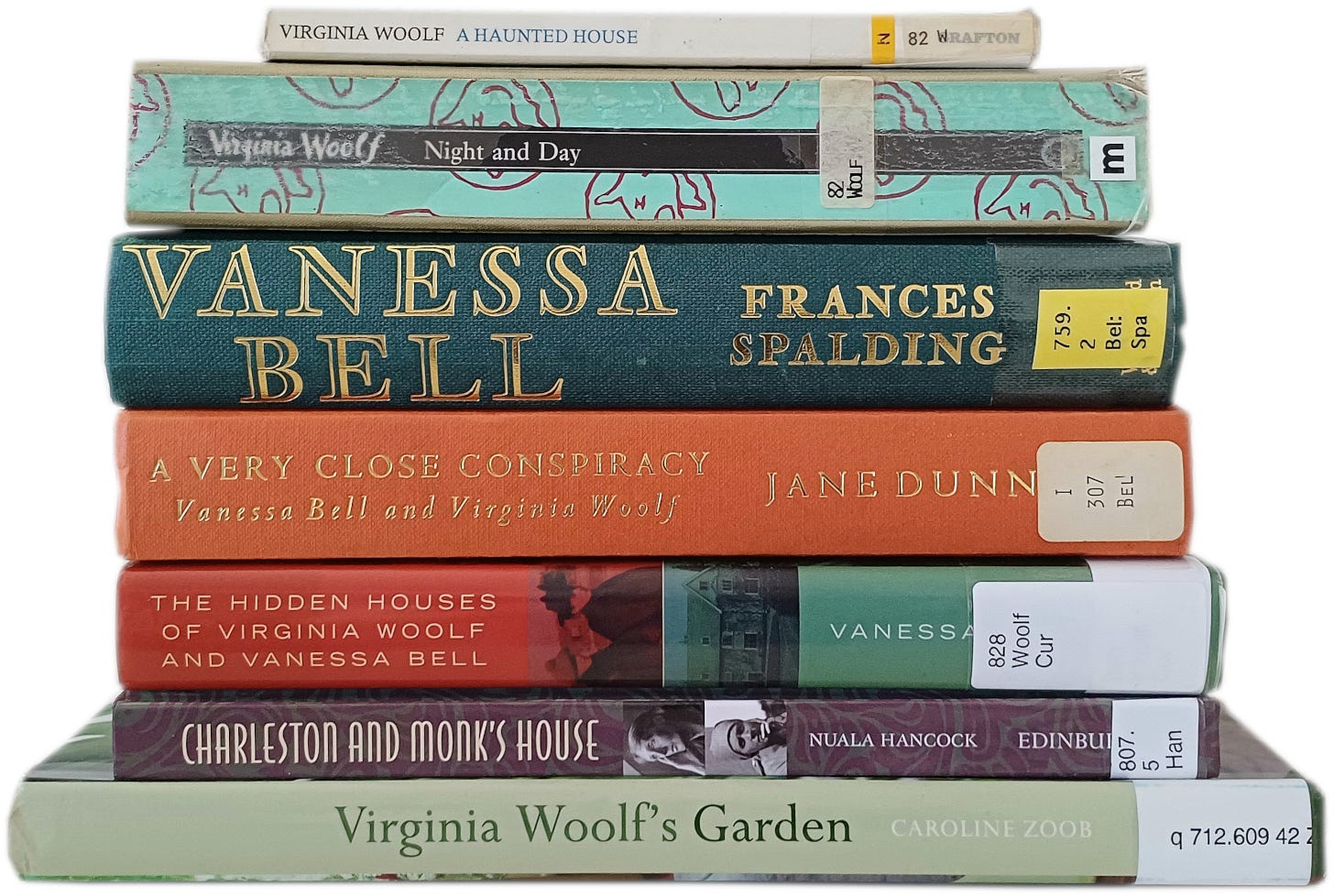
📚 Books read and mentioned:
Night and Day — Virginia Woolf
A Haunted House and Other Stories — Virginia Woolf
Vanessa Bell — Frances Spalding
Virginia Woolf and Vanessa Bell: A Very Close Conspiracy — Jane Dunn
The Hidden Houses of Virginia Woolf and Vanessa Bell — Vanessa Curtis
Charleston and Monk’s House: The Intimate House Museums of Virginia Woolf and Vanessa Bell —Nuala Hancock
Virginia Woolf’s Garden: The story of the garden at Monk’s House — Caroline Zoob
My reading during July continued the Bloomsbury theme I began in June. What started as a simple desire to revisit Virginia Woolf gradually expanded into a month-long exploration of the lives, art, friendships, and creative worlds of Virginia Woolf and her sister Vanessa Bell.
One of the things I enjoy most about themed reading is how books begin to speak to one another. A novel illuminates a biography. A collection of letters sheds light on a painting. A house, a garden, or a friendship suddenly becomes a key to understanding a work of art. Rather than moving from one isolated book to the next, I find myself entering a larger conversation.
This month’s reading included Virginia Woolf’s Night and Day, her collection A Haunted House and Other Stories, several biographies of Vanessa Bell and Virginia Woolf, and books exploring the houses and gardens that shaped their creative lives.
A highlight was revisiting Night and Day. It had been many years since I last read it, and I had forgotten how much warmth, humour, and gentle satire Woolf brings to the story. Set in a changing pre-war London, the novel explores love, duty, ambition, and personal freedom through the lives of four young people. Although often overshadowed by Woolf’s later modernist masterpieces, I found it a deeply enjoyable novel that raises those enduring questions about love, marriage, and what makes a meaningful life.
I also read A Haunted House and Other Stories, my first encounter with Woolf’s shorter fiction. These stories surprised me. They often feel fleeting and luminous, almost like prose poems, capturing moments of consciousness with remarkable delicacy. Reading them gave me a new appreciation for Woolf’s ability to compress emotional and psychological depth into only a few pages.
Much of the month, however, belonged to Vanessa Bell. Frances Spalding’s biography, Vanessa Bell, offered a rich portrait of Bell as an artist in her own right rather than simply Virginia Woolf’s sister. I have long admired Bell’s paintings, with their contemplative quality and bold use of colour, and this biography deepened my appreciation for both her work and her role within the Bloomsbury Group. Reading alongside Jane Dunn’s Virginia Woolf and Vanessa Bell: A Very Close Conspiracy added another layer, revealing the complexity of the sisters’ creative relationship and the ways they influenced one another throughout their lives.
The books exploring Charleston, Monk’s House, and Woolf’s garden were perhaps the most unexpectedly delightful reads of the month. They reminded me how much place matters to creativity. Homes are not simply backgrounds to a life; they become containers for memory, work, relationships, and imagination. Seeing these spaces through photographs, archival material, and thoughtful commentary brought the lives of Bell and Woolf into sharper focus.
Reading this way—through a theme—is how I naturally approach books.
I rarely read a single book from beginning to end before moving on to the next. Instead, I tend to read several books at once. Over time, I’ve developed a loose structure that works well for me. Usually there are one or two works of fiction at the centre. Around them, I gather related nonfiction, biographies, letters, essays, poetry or art books. Sometimes I add a short stories, or even manga for variety. Often there is also one longer-term book that I read slowly over weeks or months.
The goal isn’t efficiency. It’s conversation.
When a shared theme connects books, each one enriches the others. Reading Virginia Woolf alongside biographies, art history, and books about Vanessa Bell’s Charleston and Monk’s House created a fuller picture than any single book could have offered on its own.
Of course, themed reading isn’t the only way to read. A wonderfully satisfying reading experience can come from pairing a single novel with a related nonfiction work—or from reading entirely unrelated books selected simply because they complement one another in mood or interest. The point is not the system itself but discovering a reading rhythm that invites curiosity.
Lately, I’ve also been thinking about rereading.
For many years, I felt there were too many unread books waiting for me. Why return to something I’d already read when there were countless discoveries ahead? Yet over the last year, I’ve felt an increasing pull back toward certain writers, places, and ideas.
Rather than resisting that impulse, I’m beginning to trust it… leaning into it.
I don’t think rereading stands in opposition to a growing TBR. Both can exist side by side. The books we return to reveal often something about the questions we are living with now. Perhaps that is what this Bloomsbury season has become for me: less a reading project and more a return to a conversation I wasn’t finished having.
There are far more books in the world than I will ever be able to read in one lifetime. Strangely, I find that thought comforting. It allows me to follow my curiosity without feeling the need to read everything, or any “guilt” about missing out on some books.
And right now, Bloomsbury artists, writers, and thinkers are calling me back.
What a rich place to linger!
— 🩷 —
P.S. One question I am thinking about lately is this: what is worth returning to?
Whether it’s books, writers, ideas, places, or creative interests, I’d love to hear what keeps calling you back.
Hi Tracy, I love the idea of theme reading and it's a bit what I'm doing now with George Sand but I'm so eclectic and dispersed (is it the correct adjective to say I'm "all over the place"?) that I read other books that have nothing to do. Among others there is 50 Great Short Stories (Bantam Classics) and what's in it…? A Haunted House by Virginia Woolf! So I've read it and this short story is really like you describe, a bit like travelling in a dream. It's difficult for me to think of a book I'd like to return to as I feel like you did before about all the books I will not be able to read in my lifetime and would like to discover more. The reflections you trigger with your publications are really precious and enriching! And btw, I love Vanessa Bell, too! Wishing you a lovely day, my Friend! 💖💖💖
I have favorite books that I often revisit from time to time like an old friend. I enjoy them just as much the second, third or even fourth time around. To be honest I have a difficult time finding much pleasure in many of the modern books that are being written today. I enjoyed reading about your books and suggestions. One book I am enjoying reading at the moment is Miss Eliza's English Kitchen by Annabel Abbs. It is about the Victorian Cook Eliza Acton. Quite enjoyable. I am also reading a book called, Silent Souls Weeping by Jane Clayson Lawson and Mrs Walford by Brenda Tyedmers. Thanks for all that you share dear friend. I hope you are having a lovely summer! Hard to believe it is half over! Yikes! xoxo