
June Reading Notes
The Bloomsbury Group and Beyond...

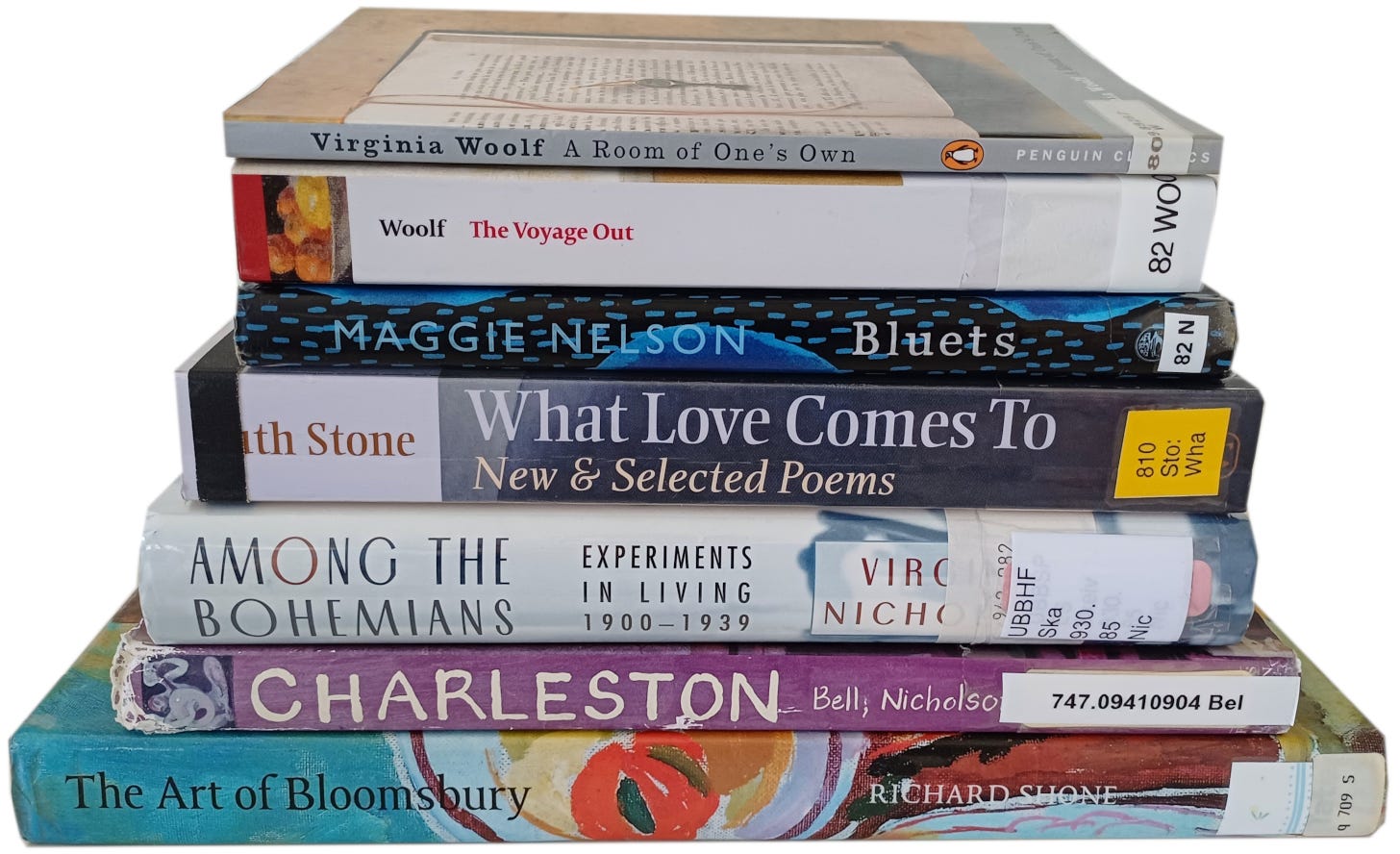
“We were full of experiments and reforms. We were going to do without table napkins – we were going to paint, to write, to have coffee after dinner instead of tea at nine o’clock. Everything was going to be different...”
— Virginia Woolf
June felt like a month of reading that revolved around questions rather than answers.
Questions about how we live, how we create, how we love, and how we become ourselves.
📚 Books mentioned:
Among the Bohemians: Experiments in Living, 1900–1939 — Virginia Nicholson
The Voyage Out — Virginia Woolf
A Room of One’s Own — Virginia Woolf
Charleston: A Bloomsbury House and Garden — Quentin Bell & Virginia Nicholson
The Art of Bloomsbury — Richard Shone
Bluets — Maggie Nelson
What Love Comes To — Ruth Stone
Arturo’s Island — Elsa Morante
Looking back, I see that many of the books I returned to this month were quietly in conversation with one another. Some through history, some through fiction, some through poetry. But all of them, in one way or another, were books about being.
Several of these were rereads. Several are still unfolding in my mind. None of them feels finished. And perhaps that is why I find myself writing about them here, rather than attempting a neat summary or verdict.
This is less a wrap-up and more a set of reading notes from a month spent thinking with books.
Reading as a way of living.
A Month in Bloomsbury
Without quite planning it, much of June became a return to Bloomsbury.
At the centre of this reading was Virginia Nicholson’s Among the Bohemians: Experiments in Living, 1900–1939, a book I first read when it was published in 2002 and returned to again more than twenty years later.
What struck me most in this rereading was not only the extraordinary cast of figures—Virginia Woolf, Vanessa Bell, Duncan Grant, Roger Fry, John Maynard Keynes, E.M. Forster, and the many others orbiting their world—but the structure of the book itself.
Rather than treating Bloomsbury as a linear history, Nicholson organises it around the texture of life: love, beauty, sex, food, money, clothing, interiors, travel, society.
It is, in other words, not only a story about what they made—but about how they lived.
And that distinction feels important.
What continues to draw me back to Bloomsbury is not simply their work, but their willingness to treat life itself as something open to experimentation. Not always successfully. Not always comfortably. But with a sense of possibility that still feels striking today.
What if we lived differently?
Not as a slogan. Not as a doctrine. But as a question.
A question that sits quietly at the centre of so much of their art, their writing, their relationships, and their homes.
Alongside Nicholson, I spent time rereading Virginia Woolf’s The Voyage Out and A Room of One’s Own. Reading Woolf in different forms at once—fiction and essay, early work and mature argument—brings into focus just how consistently she returned to questions of independence, creativity, and the conditions needed for a life of thought and making.
I also spent time with two art books: Charleston: A Bloomsbury House and Garden and The Art of Bloomsbury. These books remind me that Bloomsbury was never only literary. It was visual, domestic, material. A way of arranging space, colour, objects, and the paraphernalia of daily life as part of the same creative impulse.
Something is compelling about that refusal to separate art from living.
Other literary companions
Alongside Bloomsbury, I found myself moving through a different register of reading—more fragmentary, more interior, more poetic.
Maggie Nelson’s Bluets is one of those books that resists categorisation. It moves between essay, diary, philosophy, and fragment, circling the colour blue while also circling love, desire, grief, perception, and attention. It asks less to be “understood” than to be lived with.
Ruth Stone’s poems in What Love Comes To offer something quieter but equally enduring: an attention to the ordinary textures of life—love, loss, memory, ageing, and survival. Her work feels grounded in the lived world in a way that lingers long after reading.
And finally, Elsa Morante’s Arturo’s Island, which I read as part of a buddy read, sits somewhere between fiction and fable—an exploration of imagination, isolation, and the painful process of growing up and the complexities of being young and trying to understand life.
Books About Being
Looking back, I don’t think this month can be reduced to a list of titles or recommendations.
What connects these books is something simpler and more difficult to define: an interest in what it means to be alive.
How we shape a life.
How we pay attention.
How we love and lose and remember.
How we create meaning from experience.
How do we become ourselves?
Some of these books explore those questions through the lens of history. Some through fiction. Some through poetry. Some through fragments of thought.
But all of them, in their own way, are books about being.
And I think that is why they have stayed with me.
Not because they are finished.
But because they are still unfolding.
Reading as a Way of Living
I have been thinking a lot lately about reading not as consumption, but as a way of living.
Not as something separate from life, but as something that shapes how life is seen, felt, and understood.
Perhaps that is the thread running through all of this.
Reading as a way of living.
How we evolve because of the books we choose.
And living, in turn, is something we are always still learning how to do.
With LOVE,
Tracy 🩷
P.S. 📚If you’ve read any of these books—or if your own reading life has been circling similar questions—I’d love to hear what has been staying with you lately. What did you read this month?
'Reading as a way of living.' Six words that I find deeply thought-provoking. Books have traveled with me and have been my constant companion since childhood. They were my only friends when my parents moved their young family from Britain to Australia many years ago. A place that will never be home to me. Books and their infinite stories, wisdom, and beauty became my heart's home and my soul's comfort all these years. I have no words to express the gratitude I feel for them as companion's on my life's journey. I recently and unexpectedly entered hospital with a severe viral infection and in the urgency of getting medical care, I had no books. When I finally came home, it was to my beloved books I turned. I also wanted to catch up with your videos and sub-stack essays and poetry. Tracy, you cannot imagine the joy this has given me. Your statement of reading as a way of living could not have come at a better time. It has allowed me to rethink how I see books in my life and I am excited to put - reading as a way of life - into practice as I now move on. As always, your eloquent, meaningful, and wise words were, yet again, a timely joy. So a heartfelt thank you, Tracy. Wishing you blessings and lovely days.
As always your essays are a subtle but deep treat of discovering, moving close to, and finally merging with the beauty of the world. When I was first discovering the magic of Virginia Woolf I would be so transported by her immersive writings but at the same time would visit my favorite rare book store to gently handle their early Woolf editions with the stunningly lovely and lively dust Jacket's designed by Venessa Bell, and when I started viewing her paintings and photography a whole new visible wonder-world opened up that not only harmonized beautifully with the literary world of Virginia but would overlap with it. Now decades later almost all of Venessa's photographs are available on line from the Tate and National Portrait Gallery and they sweep the viewer up into a wild bohemian world including Virginia that was so deeply celebratory of inner life and sensual life and a life of human depths expressed and turned to art. Then there were Roger Fry's exhibitions which predated the US Armory show and brought the world of the post expressionists and abstract painters to Britain first in 1910. We all know Virginia Woolf's line about the world changing around 1910 but what I never realized is if she weren't so measured she could have written around 1910 my friends and I changed the world for they did. Thank you for your beautiful essay that brings these things flooding up like a beautiful warm enveloping late night tsunami of beauty.